Thursday, March 24, 2011

The Duality of Heaven and Earth Hidden In Mules - Revised


The Duality of Heaven and Earth Hidden In Mules

Paul Muldoon is very adept at hiding different layers of meaning and imagery in his poetry.  A tennis match can be two boys exploring each other’s physical prowess, while also being a simple game of tennis.  “Mules” can also be read on multiple levels.  The most basic level of the poem is a child’s recounting of the conception and birth of a mule.  The form of the poem works well to take the reader full circle from asking a question, to explaining a position, and finally pondering an answer.  The poem is an extended metaphor that compares lowly barnyard animals to biblical figures.  The poem poses a question about duality of the worldly and divine in the first line, and then illustrates the narrator’s opinion through the depiction of a mule’s conception and birth.  Muldoon’s simple form succinctly contains a great deal to reflect on.
            Muldoon begins by posing a question.  The rest of the poem is organized in four quatrains.  The stanzas have line counts of four, four, three, and four.  Most sentences in the poem use enjambment.  Enjambment is used to keep the stanzas evenly spaced, and subtly indicate the comparison between the earthly and divine.  The two sentences of the first stanza both use enjambment, and are split between the parts of the sentence that depicts earthly things, and the part that depicts divine.  “Her feet of clay gave the lie/To the star burned in our mare’s brow,” and “Would Parsons’ jackass not rest more assured/That cross wrenched from his shoulders?”  The order of events in the poem is also of note.  The poem moves linearly in time after the question is asked, and Muldoon makes a point of changing tenses as the poem progresses.  The poem begins in the past tense, “We had loosed them…” “They had shuddered…” and ends in the present, “dropped tonight in the cowshed.”  By first posing the question and then ending with the narrator pointing out the farmers’ reflection on the mule’s origins, Muldoon makes the reader reflect on the events in the same order they happened for the narrator.  Each line of the poem has a meaning that relates to the theme of duality between the divine and the earthly.
            Starting with the question asked in the first line, Muldoon introduces his technique of using common phrases to get at meanings of greater importance than initially expected.  While phrases such as “best of both worlds,”  “below their belts,” and “dropped tonight” can just be thought of as their everyday meanings, Muldoon is using them for more than expected.  By asking “Should they not have the best of both worlds?” Muldoon could really be saying “why shouldn’t a mule be of both God and the earth?”  A mule is a combination of two completely different species, and the result is a creature both like and unlike both.  The horse in the story has “feet of clay,” which is an allusion to when a hero appears almost god-like, but ultimately ends up being human.  Continuing the theme of combining the earthly with the heavenly, Muldoon marks the horse in a way that evokes the Virgin Mary.  Both the horse and the Virgin have a “star burned” overhead.  A similar allusion can be made for the donkey that bears the mark of God on his back.  The metaphor of the mule as a combination of earth and heaven is continued in the final stanza. “We might yet claim that it sprang from earth…” “That we would know from what heights it fell.”  Muldoon has the farmers contemplate the mule’s origins so that the duality is highlighted to the reader.
            In the same way Modernists were making the old new, Muldoon takes the simple, everyday mule, and gives it new meaning.  While one could take his rough writing at face value as plain, he always hides much greater meaning beneath the surface.  The mule could be thought of as simply a combination of donkey and horse, but Muldoon makes it out to be much more by referencing the earthly and divine in the first stanza.  Concluding his extended metaphor in the final quatrain, Muldoon provides one last image of the combination of Heaven and Earth, “We might yet claim that it sprang from earth / Were it not for the afterbirth / Trailed like some fine, silk parachute, / That we would know from what heights it fell.”  The mule is birthed like a normal barnyard creature, and yet Muldoon points out that trailing the earthly mule is its “fine, silk parachute.”  The mule is an earthly creature that’s descent is aided by a heaven-sent provision.  In his characteristic style and reminiscent of the Modernists making the old new, Muldoon fills his poem with much more than the birth of a mule.
            Muldoon’s “Mules” is a simple narrative that works as a large metaphor for the duality of earth and the heavens.  He introduces the theme by stating a question at the beginning of the poem that asks about having the best of both worlds.  The two worlds are then implied to be the earth and the heavens.  The poem is organized to take the reader through a reflective process on the conception and birth of a mule.  Muldoon includes allusions to the worldly and divine in almost every line of the poem. The poem introduces a question about duality of the worldly and divine in the first line, and then illustrates the narrator’s opinion through the depiction of a mule’s conception and birth.


On the "Recordings" section of his website, Paul Muldoon has a reading of "Mules."
Paul Muldoon reading "Mules"


http://www.paulmuldoon.net

New Posts!

Hello all,


I will be posting revised versions of some of the papers I've written for English so far.  I thought Daniel over at Too New to Handle? explained the assignment well, so I decided to quote him.


- John

From "Individual Poetry Project: Intro" on Too New to Handle?:


Over the past month or so, our class has been working on a variety of poetry-themed projects. One of these      
was the Individual Poet Project, in which each of us as students selected a contemporary American poet 
and basically immersed ourselves in his/her life and work, focusing specifically on one (non-
compilation/"selected works"-type) book by that author.
The project evolved in its details as we progressed, and ended up consisting of four papers:

1. An analysis of a shorter poem from the selected volume of poetry
2. A biography of our chosen author.
3. Another poem analysis, this time focusing on the poem relates to the overall book and its themes.
4. A final, more detailed review of the volume.

To fulfill the details of this assignment, I'll be posting slightly revised versions of all four papers on this blog        
for your reading pleasure. Enjoy! (Driver 1)


Works Cited
Driver, Daniel. "Individual Poetry Project: Intro." Too New to Handle?. 1. Blogger. Web. 24 Mar. 2011.

Monday, March 7, 2011

Poetry and Music

Hey gang,

I don't have a lot of time to write out a full post, but I wanted to share an example of a beautiful combination of poetry and music.  In 1965 the Jazz saxophonist John Coltrane, released an historic album titled A Love Supreme.  The last track consists of John Coltrane "playing" the words of a poem he wrote that is a praise of God.  There's too much to say about it right now, but it's a beautiful piece of music and poetry, and deserves your attention.

John Coltrane - "Psalm"

Sunday, February 20, 2011

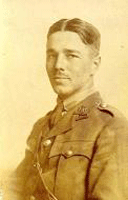
Anthem for Doomed Youth Reflection

Wilfred Owen
I enjoyed "Anthem for Doomed Youth", because it felt straight forward and honest. Owen's language is simple, and yet the subtle allusions and personification add real depth to the poem. The poem is in sonnet form. The way Owen likens the soldiers' deaths to that of cattle, and replaces their passing-bells with the blasts of artillery, makes the war seem so much more gruesome and real. Owen uses the second half of the poem to point out the youths won't be given a funeral, and works to make the reader feel even more sorrow for them. Because the first half describes the horror of the war, the second half more effectively moves the reader when illustrating the pitiful situation.


Photo:
www.poemhunter.com

Poets Against The War Reflection

This is a reflection of mine on a poem from the Poets Against The War database.

an interruption of one's routine during war

After browsing through various poems on the poets against war website, this one caught my attention. In the introduction to the poem, the poet feels the need to draw attention to the silence people have towards the reality of war. She includes this quote from Audre Lorde, “When we speak, we are afraid our words will not be heard or welcomed. But when we are silent, we are still afraid. So it is better to speak”. The poem is short and relatively simple, but I still felt very moved by it. The first half illustrates a man close to tears in a coffee shop, reading a newspaper. I felt the poet created an image of an everyday man confronting war in any everyday situation that demanded the reader to stop an think. The poem made me realize the place of embarrassment our country has been put in by our silence about war. War finally causes a man to indulge in his frustrations and break his silence in a public place, and yet he simply must buy his latte, and move on with his day. I approve of the poem’s encouragement to do more than be held captive by silence.

Comparing "The Love Song of J. Alfred Prufrock" and "Heritage"

“The Love Song of Alfred J. Prufrock” by T. S. Elliot, and “Heritage” by Countee Cullen are both ultimately poems of reflection and contemplation. Alfred J. Prufrock exhibits his uncertainties about the future, while the narrator in Countee Cullen’s poem reflects on his heritage, culture, and past. The speaker in each poem is part of what makes the poems seem so different. Alfred J. Prufrock comes off as a lazy man who is indecisive. The entire poem seems to be a quest just to gain the courage to act, let alone deciding what actions are right or warranted in his case. The speaker in “Heritage” seems much more sure of themselves, and more focused on a specific goal. The poem starts with the question “What is Africa to me:” and follows with musings on that topic
  “Heritage” uses a constant rhyme scheme while “Prufrock” does not, but when “Prufrock” does rhyme, it is in a similar AABBCC… style to Cullen’s. The presence of a fixed rhyme scheme adds to the more coherent nature of “Heritage”. Elliot’s poem is also broken into shorter stanzas than Cullen’s. This helps “Prufrock” to move at a quicker pace than “Heritage”, but it feels a little disorienting when the subject changes from stanza to stanza. The strongest theme present in “Heritage” is the speaker’s frustration at the way the white American culture limits their acceptance and expression of their African culture. The second half of the second stanza is a clear expression of the speaker’s growing distaste of the American pressure, “So I lie, whose fount of pride, Dear distress, and joy allied, Is my somber flesh and skin, With the dark blood dammed within Like great pulsing tides of wine That, I fear, must burst the fine Channels of the chafing net Where they surge and foam and fret.” The speaker’s dissent is growing greater than they can contain.
  The speaker in “Prufrock” seems most limited by his expectations. His encounters with past loved ones seem to have stripped him of his ability to venture into his own decisions. Cullen’s poem seems to be the one making something the most “new”. Instead of remaining complacent with the white oppression of African heritage, Cullen illustrates the difficulties African Americans face, and makes their struggle new. He is supporting those who want to acknowledge and work with their African past. “Prufrock” seems to be making new the question of what it means to act in the world. For both speakers, their pasts are acting to try to hold them in place and keep them from setting out upon a new course.

Introductions

Hello fellow poetry readers,

My name is John Miller and I am writing this blog for my English 210 "Intro to Literature" class at Goshen College.  The class started with poetry as a response to September 11th then moved back in time to study the rise of Modernist poetry with Ezra Pound, T. S. Eliot, and their contemporaries.  Initially I will be posting my previous reflections on different poems we've focussed on in class.  Each member of my class is starting a blog, and so I hope you will take time to follow each and every one of them.  I'm sure a collection of a dozen or so different views on a selection of poems will make for a worthwhile read.  Enjoy your time here, and be sure to join the party!

-John